|
Health and Genetics
of the Entlebucher
Welcome to the Health & Genetics page, the NEMDA home for information about Entlebucher well-being and the latest research on breeding and health. If there is a casual Entlebucher owner, we have yet to meet them. This breed is so wonderful, so smart, so…extra that it elicits a strong passion for the breed from their humans. We know that the health and wellness of your dog is a top priority, and the Health & Genetics Committee is here to be a resource.
The Health & Genetics Committee
NEMDA has an active Health and Genetics Committee (H&G) that is tasked with data collection, encouraging scientific research of the Entlebucher breed, fundraising to support research, and educational programming to keep our Entles and their owners happy and healthy. We are committed to helping Entle breeders reduce genetic disease while maintaining type and good temperament. If you are passionate and somewhat knowledgeable about science and health topics, consider joining us. Just send us a note at health@nemda.org
General Health
The Entlebucher breed is quite small in North America and are overall very healthy dogs. Entlebuchers that are products of careful, planned breeding, that are fed a healthy diet and receive regular exercise generally have wonderful, long active lives. These lives are enhanced by a regular annual check at your veterinarian's office, with blood testing and other scans, to identify developing issues as they mature. For the best outcomes, learn about common household foods and other products that are toxic to your dog, avoid play that causes twisting in the air and toys that file away teeth. As their owner, you know your dog best and will spot abnormal movement, colour or texture before anyone else. As with young children, who cannot advise when they are sick, if they seem 'off' and are not improving after a day or two, have them assessed. Hopefully it is nothing and you can all relax and get back to playing. But if there is a problem, you may have saved valuable time in the resolution of the problem.
 The H&G Committee is diligent in tracking any distinctive health issues that arise consistently in our population. How do we know what's happening with all the Entlebuchers in North America? We rely on owners, just like you! When you experience a health problem with your dog, please take a moment to let us know. You can send us a note at health@nemda.org. You can complete the online health survey update at any time. And you can always check the box on OFA testing form and add your initials to publish all results.
If that little box is not initialed, the results show up in the OFA statistics but there is no way for H&G or any researchers to identify the affected dog. If we don't know the dog's name and microchip, we can't investigate pedigree blood lines and there's no point in trying to do DNA research. Even if the test was done a while ago, the OFA will allow you to add your initials and release the results, helping researchers to solve painful and deadly disease.
We are especially concerned about issues that cause death, significant pain for the dog or are difficult to manage. Traditionally, our focus has been:
- Orthopedics (bones & joints),
- Eye (cataracts, glaucoma, PRA-prcd),
- Renal (kidney, ureters, bladder etc),
- Immune (AIMA, allergies),
- Ears (cleaning, dork ear), and
- General Health (swimmers tail).
Orthopedic Hip/Knee Issues: NEMDA BCOE Breeders are required to obtain OFA (Orthopedic Foundation of America) hip evaluations of all breeding stock. Hip Dysplasia is often seen in older, less well-bred, larger dogs and causes significant gait changes and ongoing pain and disability. Similarly, luxating patella, or slipping knee cap, creates a painful hitch in the dog's every step.
Evidence shows that when parents have good solid joints, most of their offspring inherit the same good solid joints. Screening all breeding dogs, using OFA X-rays, provides a graded view of joint stability. Removing dogs, with poorly seated joints from the breeding pool, eliminates many puppies that would mature to develop these same painful conditions.
Although it is not required, breeders encourage puppy owners to also obtain the OFA health screening x-rays. This information helps breeders adjust their mating practices and ensure the future orthopedic health of their puppies. In the past 20 years of evaluations, OFA reports that statistically, 80% of the Entlebuchers evaluated have received passing evaluations from the OFA. More information on Hip & Knee issues in Entlebuchers can be found here: https://nemda.org/Hip-and-Knee-Issues
Eye Health: Regrettably, painful, life-altering eye conditions occur in Entlebucher Mountain Dogs with some regularity. NEMDA highly recommends Entlebuchers receive an annual eye exam along with their routine health exam. Your regular veterinarian can have a quick look inside the eye, but for a more detailed investigation, you will need to see an Ophthalmologist. Eye diseases that are known in Entlebuchers include Progressive Retinal Atrophy (PRA), Cataracts and Glaucoma.
We have successfully identified the genes that cause PRA-prcd, a progressive blindness similar to macular degeneration in humans. We now test dogs before breeding and selectively mate to eliminate the future of this disease from our breed. This is a great success story.
We are working to better understand the inheritance patterns of glaucoma, which has become more common in our breed. At the moment we can neither predict nor effectively stop this disease once it is started. Glaucoma is incredibly painful as the pressure behind the eye builds and the fluid cannot escape. It can occur very quickly and inevitably causes blindness in the affected eye. Often the second eye is soon to succumb to the same fate. We have an ongoing research study under Dr. G. McLellan studying glaucoma, specifically in Entlebuchers. If you would like to help, please obtain a blood based DNA kit and send it in for analysis. Older dogs, over 9 years of age, are especially needed to shed light on natural healthy changes in the eye vs the glaucoma related changes we fear.
Cataracts are common in many dog breeds and Entlebuchers are not immune. Similar to elderly humans, the lens becomes cloudy, restricting light entry and creating a fuzzy view of the world. Cataracts progress over time, reducing vision. Surgery is possible, but it is not the routine, successful procedure that we hear about for humans. Cataract surgery can be expensive and is not without risk. Any physical manipulation of the eye is prone to error which can cause a secondary glaucoma - the same nasty disease from an unnatural cause.
In addition to helping fund research on prevention and treatment, NEMDA also works to screen for possible eye maladies prior to breeding. At this time, we can selectively breed to eliminate PRA but Cataracts and Glaucoma remain as serious threats. Reach out to us at health@NEMDA.org for immediate assistance and please check https://nemda.org/Eye-Health for all up-to-date news in this area.
Renal: Ectopic Ureter (EU) is a disease of the renal/urinary system caused by a congenital abnormality at the "trigone" or junction of the ureter and bladder. Normally, the two ureters descend from each kidney and join the bladder near the vertical top. Sometimes, for unknown reasons, the ureters attach in alternate locations or may not attach at all. Both males and females may be affected although symptoms are more often observed in females.
Some dogs with ectopic ureter are completely asymptomatic, showing no signs of any problem at all. Others, may have occasional leaking of urine, constant dribbling of urine or urine pooling when resting. If you have a puppy that just can't seem to figure out house training, and continues to dribble urine as he moves or leaves urine pools behind where he was sleeping, ask your veterinarian about ectopic ureter. The condition can also arise as frequent unresolved bladder infections. However the symptoms arise, it is difficult to manage - no more sleeping in your bed if you leave urine puddles behind. Untreated ectopic ureter, at the extreme, can cause significant pain, renal failure and death.
Diagnosis starts with an ultrasound scan of the ureters. Unfortunately, this scan can be quite tricky and it may require a specialist to be able to accurately visualize the system. Treatment depends on the severity of the abnormalities. Sometimes, surgery can physically moveand attach the ureter in the correct location but in other cases the resolution is much more complicated.
At this time, we believe the genetic heritance involves more than a single gene, which makes identification and prevention difficult. Because of the 'silent' nature of the disease it is hard to track the disease in breeding lines. We do not yet have screening or grading of breeding dogs to predict or prevent this malady in offspring. For more information on diagnosis and treatment, visit: https://nemda.org/Entlebucher-Urinary-Syndrome
Immune: Auto-Immune Mediated Anemia (AIMA) and allergies have been identified in a number of Entlebuchers but are not common problems in our breed. AIMA is a disease where the body's immune system mistakenly attacks red blood cells. It can be very serious although in some cases, a low dose steroid can 'turn down' the immune response and allow for a normal, active life.
Allergies can be a significant issue for dogs and their families. Often it is difficult to determine what is causing the extreme itching in order to avoid those allergens. If you suspect allergies in your Entlebucher, chat with your veterinarian about how to identify the trigger. Sometime grasses, pollen and other environmental triggers are the cause - and are virtually impossible to avoid. Wiping the face, belly and feet with a clean, damp cloth when you come indoors may provide relief. Other times, switching to a different diet can make a big difference - limited ingredients, alternate protein, eliminate grains. Owners have had some success with changing to a limited ingredient diet and alternative veterinary treatment. Resolving allergies is a long haul project - many improve over time with a variety of approaches, even if it never totally goes away.
It is likely that the predisposition to immune related illness may be inherited to some degree although exposures and illness fairly early in life, are also suspected. Long term stress is not good for any of us and can lead to immune problems. Work toward a fun, active life and do your best to avoid known triggers.
Summary - With all of the information above discussing ailments we have seen in Entlebuchers, we would be remiss if we did not point out that these issues are rare. The body is a complex organism with many inter-related parts. In Entlebuchers, we have not seen any consistent issues in any of the following areas: lungs & airways, heart, organs (liver, spleen, pancreas), brain & nervous system. Our breed remains quite healthy, overall.
Raising a Healthy Entlebucher
Exercise
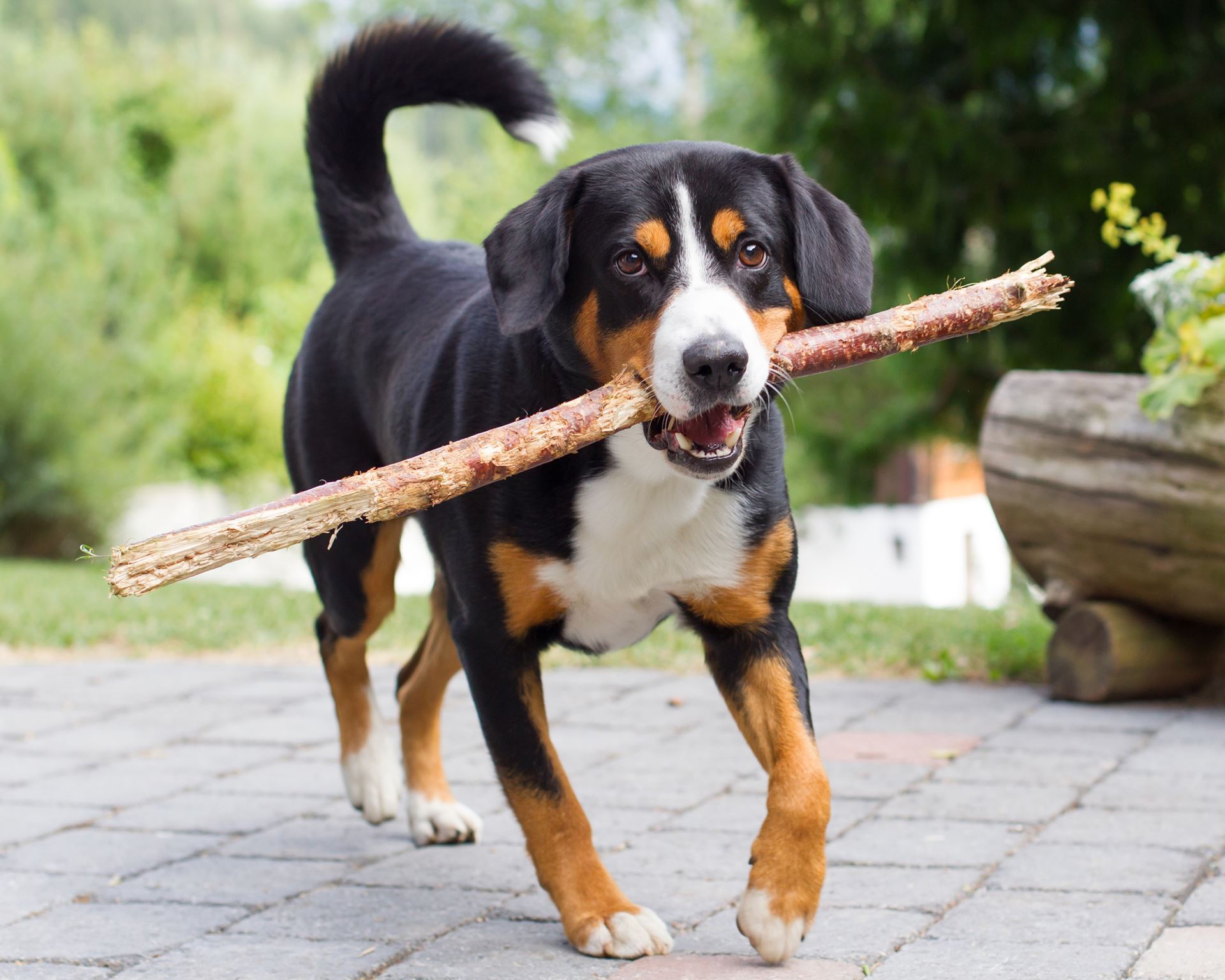
The intensity Entlebuchers display in their love for you extends to their pursuit of physicality! Getting plenty of exercise is key for an Entle’s physical and mental health. These dogs can really play and run and fetch until you tell them it’s time to hit their “off” switch and the key is helping them regulate themselves. Entlebuchers most certainly need exercise every day but what is the best way to exert these fantastic dogs while keeping them safe?
- Walks- a typical Entlebucher can enjoy up to a 3 mile walk in comfortable temperature.
- Running- short distances at moderate speed is fine for our short legged friends but running distances could cause strain on legs and hips.
- Fetch- boy oh boy
- Frisbee- We advise against playing frisbee. The long length of an Entlebucher body makes the jumping in this activity ripe for injuries like torn CCLs.
Diet & Body Condition
Research has shown that all dog food is not created equal. Animal byproducts and other things that should not be in food have become common as pet care has become big business. To ensure the long-term health of our Entlebuchers, here are some things we look for when making choices about food. As with humans, fresh food provides better nutrition than highly processed food. There are many ways to feed your dog - we suggest you avoid the 'cheapest' grocery store kibble, look for a product made by a local company (vs. overseas), check the ingredients for actual 'meat' content and watch for additives (flavour enhancers, desiccants, emulsifiers). Give them vegetables, especially the scraps as you prepare salad, or frozen mixed vegetables. Like toddlers, anything frozen is more fun! Even 10% fresh food on top of their regular kibble makes a difference to their health.
The most important thing you can do to improve and maintain a healthy dog is to avoid over feeding. Obesity is a pet epidemic, especially in North America. Know your pet's appropriate weight from the vet's office and limit their ration to maintain this weight. You can literally add years to their lives in this way alone. They will be less prone to other disease and live a healthier life, be more active and definitely have more fun.
Household cleaners, anti-freeze and many other products can cause toxicity in dogs. Always keep these items secure where your dog can not access them. Certain “human” foods can also be toxic for dogs. You might be inclined to slip your Entle a bite of burger now and then but some foods can cause your dog abdominal pain, vomiting, diarrhea, or could even be lethal. A more exhaustive list can be found here but we like to point out the following poisonous foods to avoid:
- Onion, onion powder, garlic
- Grapes
- Raisins
- Chocolate - dark is worse
- Alcohol
- Aspartame, Xylitol, Birch sugar
Don't leave your sugar-free gum and candy out in the vehicle with your dog. Always lock up chocolate in the fridge. Raisins can be particularly toxic - keep those in dog proof locations. If your dog has ingested any of the above, we recommend calling your vet or the Pet Poison Hotline immediately.
Mental Health
Entlebuchers are often called “The Smiling Dog” for the delightful grin on their faces and keeping these enthusiastic yet highly sensitive smiling is a big part of a healthy Entlebucher life. Entlebuchers like to have a job to do - after all, they were bred to herd livestock in the Swiss Alps! If they are not given a job, they will make up their own jobs (often ones you may not want them to do, like herding the entire family or sneaking into the garbage!). Entlebuchers have a focused intensity and love structure and routine. You may have noticed by now that your dog wants to be with you all the time and whatever you think is fun, they think is fun. Don't stress about finding a herd of cattle for your dog, but do include them in your regular routine. Their job can be bringing in the mail, collecting the laundry, or just alerting you to deliveries. Be excited with them so that they know they are appreciated for their contribution to the 'pack'.
Entlebuchers that do not receive sufficient socialization opportunities as young pups can develop significant mental health challenges. They may be afraid of any woman, any one with a hat, all mobility equipment for example. Make sure that you expose your dog to as many human situations as you can, while they are young, if possible. It is never too late to work on sensitivities - if you give them a treat every time that annoying dog comes by, the one that they bark their head off about, and redirect their attention to you and the treat, you can change their programming. You will need the treats when the dog approaches but you can avoid the barking.
Open Houses
In our efforts to bring the latest and most relevant Entlebucher health topics directly to you, we host online Open Houses. They are livestreamed and then archived on the NEMDA YouTube channel, free for members to attend and feature researchers, veterinarians, and other experts discussing issues facing Entlebuchers and their families. Some previous topics include: Tick Talks, the Prevention and Rehabilitation of CCL Injuries, and the Health Benefits of not spaying or neutering. Browse our past Open Houses and sign up for the upcoming event here.
Research
Research and data play a vital role in achieving our goal of healthy and sustainable breed growth. The number of Entlebuchers in North America is quite small and do not attract big research dollars. The Health & Genetics Committee stays abreast of research being done by 3rd party veterinarians and experts in the field and shares that information with our members. For example, we hosted an Open House on CCL Injuries and Prevention and invited a veterinarian who specializes in these types of issues after hearing from members that this was a concern with the Entlebuchers.
How do we know what is important to Entlebucher owners? The reason we can bring accurate and actionable information to you is through our data collection and research. Which brings us to our next topic, health surveys and updates from you.
Health Survey
An incredibly valuable way we can come together on the NEMDA platform is with information sharing. Please consider contributing to the NEMDA database and share your personal experiences with your Entlebucher’s health. This information is vital in identifying consistencies across the breed with health concerns AND positioning ourselves to best support our members. Click here to get started.
Health Testing
NEMDA has developed a group of diseases for which we can screen and prevent future illness. These disease screening tests are required on all breeding dogs prior to mating. In this way, we can work to gradually improve the overall health of the breed and eliminate some conditions that are deadly, painful or difficult to manage. NEMDA's Breed Code of Ethics (BCOE group) breeders commit to performing these health screening tests and selecting mates to improve the breed type, temperament and health with every litter they produce. You can learn more about the health tests and the breeder committments here.
Questions or Concerns? Contact us at: health@nemda.org
|
|
|




Copyright ©2026, National Entlebucher Mountain Dog Association. All Rights Reserved. |